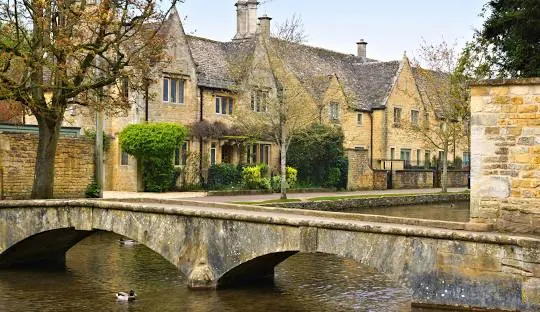
The Five Bridges of Bourton-on-the-Water: 2,000 Years of Cotswolds History
Our oldest surviving village-centre bridge was built when Oliver Cromwell ruled England. Our youngest commemorates the coronation of Queen Elizabeth II. And the story goes back much further still.
 Sarah18 min read
There is something rather wonderful about standing on an old stone bridge and wondering who might have crossed the river before you. Here in Bourton-on-the-Water, our five famous bridges span nearly 300 years of construction history. But the story of crossing the River Windrush goes back much further, almost 2,000 years, to the Romans.
Our oldest surviving village-centre bridge was built when Oliver Cromwell ruled England. Our youngest commemorates the coronation of Queen Elizabeth II. And beyond the familiar village green lies an even older crossing, where Roman travellers once passed along the Fosse Way.
These bridges are part of what makes Bourton such a special place to visit. They are also a wonderful introduction to Cotswold life, from Roman roads and medieval farms to Georgian cottages, village mills and the arrival of modern tourism.
So come with me for a little journey through Bourton’s history. We’ll begin long before the Cotswolds became a fashionable place to spend a weekend.
When Were the First Bridges Built in Bourton-on-the-Water?
Long before there were picturesque stone bridges and visitors photographing the River Windrush, people needed to cross it.
The Romans arrived in Britain in AD 43, and by the late first or early second century, a settlement had developed beside the Fosse Way, just west of today’s Bourton village centre. The road connected important Roman towns, including Corinium, now Cirencester, and provided a route for soldiers, merchants, officials and travellers.
The Romans established a crossing of the Windrush here, although nobody knows precisely when the first bridge was built. Archaeological evidence points to a Roman ford beneath the modern road bridge, while Historic England records that the crossing was first bridged in Roman times.
That places the beginnings of Bourton’s bridge-building history somewhere within the Roman period, approximately AD 100 to 400, although an earlier date cannot be ruled out.
And the Romans were not simply passing through. Excavations have revealed the remains of buildings interpreted as a posting house, a shrine, a bakehouse and even something resembling a roadside cafe.
I particularly like that last discovery. Nearly 2,000 years ago, travellers passing through Bourton apparently needed somewhere to stop for refreshments. Some things never change.
The settlement continued into the early fifth century, when Roman rule in Britain came to an end. Yet the crossing remained important. Roads might deteriorate, governments might disappear, but people still needed to reach the other side of the river.
Bourton’s Medieval Bridge: A Crossing Older Than Columbus’s Voyage
By the Middle Ages, Bourton-on-the-Water was a well-established Cotswold community, and the old Fosse Way crossing remained part of the local road network.
There is an intriguing reference to the site as Buruhford of Salmonsbury in the eighth century, suggesting that the ford was still an important local landmark. We cannot say exactly what sort of bridge, if any, stood there at that date.
What we do know is that a stone bridge existed at the Fosse Way crossing by 1483. Just think about that date. Richard III was King of England, the Battle of Bosworth was still two years away, and Christopher Columbus would not make his famous Atlantic voyage for another nine years.
Who commissioned that medieval stone bridge? We don’t know. It may have been financed through local landowners, the community or those responsible for maintaining the highway. Until we find documentary evidence, its builder remains another of Bourton’s little mysteries.
The bridge you see on the Fosse Way today is not the medieval structure. It was rebuilt in 1806, during the reign of George III, and widened in 1959. But it occupies a crossing with a history reaching back to Roman Britain.
I find that rather extraordinary. Cars now travel over a stretch of river that Roman travellers were crossing when much of Britain was still governed from Rome.
Mill Bridge, 1654: The Oldest of Bourton’s Five Famous Bridges
Mill Bridge was built in 1654, making it 372 years old in 2026. Originally known as Broad Bridge or Big Bridge, it stands near the western end of the village green, close to the old mill. It is the oldest surviving bridge among the five familiar crossings.
England was in turmoil when it was built. Charles I had been executed five years earlier, the monarchy had been abolished, and Oliver Cromwell was ruling as Lord Protector.
Bourton had a rather personal connection with these events. The rector of St Lawrence’s Church was Dr Thomas Temple, a man with connections to the royal household. In June 1644, King Charles I visited Bourton and stayed with Temple at the Manor House, opposite the church.
Just imagine that. The King of England, whose struggle with Parliament would eventually cost him his head, was a guest in our little Cotswold village.
Temple was deprived of his rectory by Parliament in 1646. Although he regained his position following the Restoration in 1660, he never became Bishop of Bristol. He remained rector of Bourton until his death in 1667, his later years troubled by financial difficulties and legal disputes. I confess I find the truth rather more interesting than the popular version.
It was against this background, in 1654, that the people of Bourton built Mill Bridge. Cromwell was still in power, the monarchy had yet to be restored, and Thomas Temple remained deprived of his living. Yet ordinary village life continued. Farmers tended their fields, millers milled their corn, and the River Windrush flowed steadily through the village, quite indifferent to the quarrels of kings and the ambitions of men.
When you visit Bourton-on-the-Water, take a walk towards St Lawrence’s Church and the Manor House. You’ll be following a route through a village that once welcomed a king, and crossing a bridge built by people living with the consequences of his downfall.
High Bridge, 1756: Georgian Cotswold Life
High Bridge takes us forward a century to 1756, during the reign of George II. Britain was entering the Seven Years’ War, a conflict that would extend across Europe, North America and India. George Washington was still a young officer serving Britain’s American colonies, and Jane Austen had not yet been born.
Bourton, meanwhile, was developing into a prosperous Cotswold community. Agriculture, milling and local trades supported village life, while many of the handsome limestone cottages and houses we admire today were already standing.
The village also had its interesting characters. Benjamin Beddome, a Baptist minister and hymn writer, served Bourton for more than fifty years. In 1765, just nine years after High Bridge was built, the village hosted a gathering of Baptist ministers.
I rather like imagining the conversations taking place around Bourton in those days. News from London, the price of corn, village gossip and perhaps the latest trouble brewing across the Atlantic. The subjects may have changed, but I suspect the conversations would sound surprisingly familiar.
Today, High Bridge is one of the loveliest places to admire the River Windrush and the traditional Cotswold stone buildings. Pause for a moment and remember that it was already standing when George Washington was still a loyal subject of the British Crown.
Payne’s Bridge, 1776: American Independence and a Bourton Mystery
Payne’s Bridge brings us to 1776, one of the most famous years in world history. Across the Atlantic, thirteen British colonies declared their independence, George Washington was leading the Continental Army, and George III was facing a rebellion that would change the world.
Meanwhile, here in Bourton-on-the-Water, the village was rebuilding a bridge across the Windrush. I find that contrast rather delightful. On one side of the Atlantic, America’s founding fathers were creating a country. On the other, a Gloucestershire village was improving its river crossing.
But there’s a little mystery about Payne’s Bridge that has been intriguing me. Who was Payne, and why does the bridge bear his name? Perhaps he paid for its construction, but nobody seems quite sure. There is one tantalising clue. A parish marriage record tells us that a John Payne married Martha Weale here in Bourton in April 1779, just three years after the bridge’s reported rebuilding. Could he be our mysterious Mr Payne? Perhaps, but I’ve yet to find the connection. I think a little detective work is called for. I’ll let you know what I discover, so watch this space.
New Bridge, 1911: How Modern Life Came to Bourton-on-the-Water
New Bridge was built in 1911, during the reign of George V, when motor cars, telephones, electric lighting and aviation were beginning to transform everyday life. The following year, the Titanic would sink on its maiden voyage. Within three years, Europe would be plunged into the First World War.
Here in Bourton, a generous local benefactor named George Frederick Moore was helping to improve village life. He provided New Bridge, sometimes called Moore Bridge, connecting High Street with Victoria Street and creating a better crossing for the growing demands of modern transport.
Moore’s generosity extended beyond the bridge. He also helped provide Victoria Hall and the former Cottage Hospital, whose building later became the George Moore Community Centre.
I rather admire that sort of generosity. There is something appealing about leaving behind not a grand statue, but a bridge that people can use every day. More than a century later, thousands of visitors cross it without necessarily knowing the name of the man who helped provide it.
Coronation Bridge, 1953: Elizabeth II and the Changing Cotswolds
Our fifth and youngest village-centre bridge was built in 1953, the year Elizabeth II was crowned at Westminster Abbey. Britain was still recovering from the Second World War, food rationing had not completely ended, and families gathered around television sets to watch the coronation.
It was also the year Edmund Hillary and Tenzing Norgay reached the summit of Mount Everest. After the hardships of war, there was a growing sense of optimism.
Bourton’s Coronation Bridge replaced an earlier wooden footbridge near the Old New Inn. Local accounts suggest that a wooden crossing had stood here since the eighteenth century, giving the site a history perhaps 150 years older than the present bridge.
The old footbridge apparently met a rather unfortunate end, collapsing while a visitor was crossing it. I do hope the poor person escaped with nothing worse than wet feet and a good story to tell when they returned home.
Children who crossed Coronation Bridge when it was new may now bring their grandchildren to enjoy the same views. Today’s ordinary moments have a habit of becoming tomorrow’s history.
Why Is Bourton-on-the-Water Called the Venice of the Cotswolds?
Bourton-on-the-Water is known as the Venice of the Cotswolds because of the River Windrush flowing through its centre, crossed by a series of low stone bridges. Together with the traditional limestone cottages and attractive village green, they create one of the most recognisable scenes in the Cotswolds.
Of course, nobody is going to mistake Bourton for Venice. We have neither gondolas nor the Grand Canal, and our bridges are rather more modest. But I think that is part of their charm.
The Windrush has shaped Bourton for centuries, providing water, powering mills and influencing where roads and buildings developed. The bridges were practical crossings, built by people who simply needed to get from one side of the village to the other. Yet today, those same crossings are among the reasons visitors travel thousands of miles to see Bourton-on-the-Water.
Almost 2,000 Years of Bourton-on-the-Water History
The oldest known river crossing is associated with the Roman settlement beside the Fosse Way, established by approximately AD 100 to 200. The precise date of the first Roman bridge is unknown, but the crossing itself is nearly 2,000 years old.
By 1483, a stone bridge stood at the Fosse Way crossing. Its present successor dates from 1806, with alterations in 1959. In the village centre, the five famous bridges span the period from 1654 to 1953, although some replaced earlier crossings.
And that is what makes the history of Bourton-on-the-Water so fascinating. The bridges we admire today are only the latest chapters in a much longer story. Before the stone bridges came wooden crossings and fords. Before the Georgian cottages came medieval houses and farms. And before any of those, Roman travellers were making their way through the Windrush valley.
Where Can You See the Five Bridges?
You can see all five famous bridges during a gentle walk through the centre of Bourton-on-the-Water. Begin at Mill Bridge, near the western end of the village green, and follow the River Windrush past High Bridge, New Bridge and Payne’s Bridge, before reaching Coronation Bridge near the Old New Inn.
Along the way, explore the old streets, admire the traditional Cotswold cottages and visit St Lawrence’s Church, with its connections to the English Civil War. There are independent shops, traditional pubs, cafes and restaurants to enjoy, and plenty of places to sit beside the river.
If you’re interested in the older history, look beyond the village centre towards the Fosse Way crossing. It is a reminder that Bourton was welcoming travellers long before anyone thought to call it the Venice of the Cotswolds.
Experience Cotswold Life in Bourton-on-the-Water
If you’re planning a visit to the Cotswolds, I would recommend spending a little longer in Bourton than the usual afternoon. The village is particularly lovely in the early morning and evening, when the busiest hours have passed. The light falls beautifully on the old limestone cottages, the river is peaceful, and you can enjoy a quieter side of Cotswold life.
I often wonder what those Roman travellers would think if they could see Bourton today. They might be astonished by the cars, the cameras and the visitors arriving from countries they could scarcely have imagined. But I suspect they would recognise the river and the need for a good place to cross it.
Nearly 2,000 years of history, and the Windrush is still flowing through our village.
When you visit, do take a moment to stand on each bridge. You may find yourself looking at Bourton rather differently once you know a little of its history.
And if you happen to see me walking beside the river, please come and say hello. I’d love to hear which bridge is your favourite.
Share this story
More from Village Life
From Bourton to the Battlefields: Lives Lost in Two World Wars
Behind Bourton's picturesque bridges and peaceful green lies another story. It is a story of extraordinary courage, personal sacrifice and families who experienced the terrible consequences of two world wars.
Read From Bourton to the Battlefields: Lives Lost in Two World WarsA Little Faith, a Lot of History and Some Wonderful Stories: Discovering the Churches of Bourton-on-the-Water
Away from the riverside photographs and busy tea rooms lies a fascinating history, much of it preserved in the village's churches. St Lawrence's, the Baptists, Benjamin Beddome and a little trip up the hill to Clapton.
Read A Little Faith, a Lot of History and Some Wonderful Stories: Discovering the Churches of Bourton-on-the-Water